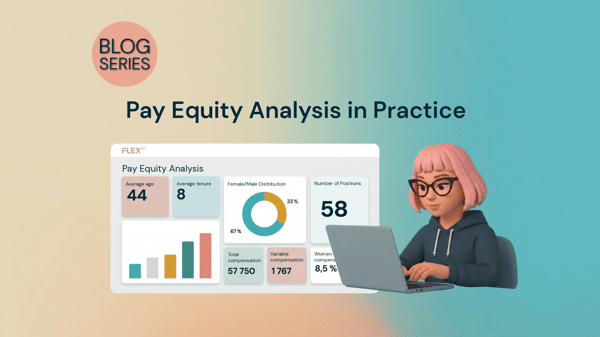
With new pay transparency rules on the horizon, pay equity analysis is becoming more important than ever. But are there other reasons to take a closer look at your pay structures and identify imbalances? Spoiler: yes – and there are more than you might think.
Identifying pay differences between women and men performing equal or equivalent work, and determining whether those differences are related to gender. In short, that is what a pay equity analysis is all about.
Under Sweden’s Discrimination Act, all employers are already required to carry out this work once a year – and the new pay transparency rules will raise the bar even further.
But pay equity analysis is not just something you have to do. It is also an opportunity. An opportunity to strengthen your employer brand, build trust among employees and make better-informed decisions when recruiting and reviewing salaries.
Read more: When pay transparency becomes law — How the Pay Equity Compass helps you meet the requirements
Eight Reasons to Conduct a Pay Equity Analysis
1. See How Your Pay Criteria Work in Practice
Many organisations have clear pay criteria and policies in place. Whether they are actually applied as intended is another matter.
A pay equity analysis reveals how managers interpret and use those criteria when making pay decisions. It often brings inconsistencies and grey areas to the surface, creating an opportunity for dialogue and a more consistent approach across the organisation.
The result? Fairer and more consistent pay decisions over time – and a better understanding of the process among both managers and employees.
Read more: Guide: How to Create Clear and Sustainable Pay Criteria
2. Set Starting Salaries at the Right Level
Getting starting salaries right matters. You need to attract the right talent without allowing salaries to drift to levels that become difficult to manage later on.
A pay equity analysis helps you understand how salaries for new employees compare with those of colleagues in similar roles.
The statutory pay equity analysis focuses on pay differences between women and men performing equal or equivalent work. But the same structured pay data can also support broader business analysis, helping you identify other patterns – such as differences between departments or between newer and more experienced employees.
With those insights, you can refine your guidelines for new hires and build a more consistent and equitable pay structure.
It also becomes easier to benchmark salaries against the market, because you know exactly what you are paying today and where your salary levels need to be to remain competitive.
Read more: What Salary Should We Offer? How to Bring Market Pay and Salary Ranges into Your Pay Equity Analysis
3. Understand How Your Salaries Fit Together
Does it sometimes feel as though certain salaries simply “ended up where they ended up”?
By analysing average salaries and pay distribution across different roles, you get a clearer picture of how your pay structure works in practice. How large is the gap between junior and senior employees within the same occupational group, for example? And are there departments that stand out?
In short, you gain an overview that makes it easier to build a logical and coherent pay structure – with a clear rationale that both managers and employees can understand and support.
4. Clarify Roles and Responsibilities
An important part of pay equity analysis is assessing what a job actually involves. That means looking beyond job titles and examining the demands different roles place on employees in terms of responsibility, skills, working conditions and complexity.
A job evaluation gives you a deeper understanding of how different roles relate to one another and which jobs can be considered equivalent.
5. Strengthen Your Employer Brand
A pay equity analysis is more than an internal tool. It also demonstrates that equal pay for equal work is not just a principle on paper, but something your organisation actively works towards.
And that matters – both to the employees you already have and to the people you want to attract in the future.
When pay decisions are made using clear and transparent principles, employees are more likely to feel fairly treated, recognised and motivated.
The point is simple: pay equity analysis builds trust. It also strengthens an employer brand that signals structure, consideration and a genuine commitment to fair pay.
6. Bring More Facts into Your Salary Review
How do you make salary review decisions today? Are they driven by data, or does gut feeling sometimes play a bigger role than it should?
Once you have completed a pay equity analysis, you are likely to be sitting on a wealth of useful information. You know where the imbalances are and what actually needs to be adjusted, making it easier to make decisions that are both fair and well founded.
And the value does not stop there. The analysis also supports more transparent individual pay setting, where each employee’s salary can be understood and explained – both by the person making the decision and by the person receiving it.
7. Identify Imbalances Beyond Gender
Pay equity analysis is not only an effective way to uncover gender-related inequalities. It can also reveal other patterns in your pay structure.
Perhaps new hires are earning more than colleagues with longer experience. Or certain age groups or departments may consistently sit above or below others without a clear reason.
Spotting these imbalances early gives you the opportunity to address them before they become embedded in your pay structure.
8. Prepare for New Requirements and Reduce Financial and Legal Risk
Finally, there is one issue that is particularly difficult to ignore right now: the upcoming pay transparency requirements.
The EU Pay Transparency Directive places greater demands on employers to explain, document and report how pay is determined. And for organisations that do not have a clear view of their pay structure, the consequences can be costly – including the risk of sanctions, compensation claims and a weaker position in pay discrimination disputes.
Doing the groundwork now means you will not have to start from scratch once the Swedish rules are in place.
It also reduces the risk of difficult-to-explain pay differences only coming to light once someone else starts asking the questions.
Get More Value from Your Pay Equity Analysis with Pay Equity Compass in Flex HRM
Do not let the value stop once the analysis is complete.
With Pay Equity Compass in Flex HRM, you can bring the entire process together – from job architecture to a completed action plan – without messy spreadsheets, chasing down data or duplicating work.
This makes it easier to meet legal requirements while also using the insights to support fairer pay, clearer roles and better-informed decisions.
In short: a smoother way of working that prepares your organisation for what is ahead while creating value throughout the year.
Want to know more? We would be happy to hear from you.