Preparing for this year’s salary review? There are many moving parts, and several stakeholders are involved in the process of setting new salaries. But with solid preparation and the right tools, many common pitfalls can be avoided. Here are four ways to work smarter.
What Is a Salary Review?
A salary review is the recurring process in which an employer evaluates and adjusts employees’ salaries. It is usually carried out annually and is based on factors such as the organisation’s financial situation, market conditions, performance, responsibility, and internal pay principles.
In organisations covered by collective bargaining agreements, there are often clear frameworks for how and when salary reviews should be conducted. In the absence of such agreements, the responsibility lies entirely with the employer to define the structure, criteria, and process for the salary review.
Why Is It Important?
A well-executed salary review creates clarity, motivation, and trust within the organisation. When pay decisions are based on clear criteria and a well-thought-out process, it becomes easier for employees to understand how salaries are set and how they can develop over time.
In turn, this makes the salary review an important tool for retaining talent, strengthening engagement, and guiding behaviours in line with organisational goals.
Last but not least, as demands for pay transparency and documentation around pay-setting continue to increase, a structured salary review process is becoming increasingly important. A clear process reduces the risk of arbitrariness and conflict and makes it easier to respond to both internal and external questions about fairness and equal treatment.
How to Carry Out a Salary Review
There are many things to keep in mind and many parties involved in the process of reviewing salaries. Make sure to make thorough preparations and let user-friendly tools help you along the way – and you will be able to navigate through many of the most common pitfalls. Let us present you with our top four tips on how to work smarter with the company's salary review.
1. Get a Handle on the Wage Structure
Before you can start the process of determining new salaries there is a great deal of preparations to be looked over. You and your fellow managers have to:
- Discuss the preconditions for the salary review in your company. This includes, among other things, the company's salary policy and salary structure. Are your wage levels reasonable when it comes to recruiting new staff and to keep existing key resources, or are any changes necessary? Is there any risk of wage discrimination and what measures could be taken to prevent it?
- Make sure that it's clear to everyone which mandate and influence everyone has in determining new wages – to avoid any uncertainties in the dialogue with the employees.
- Update yourselves on collective agreements, local agreements and any ongoing collective bargaining.
- Look at the size of the pay pot and coordinate your suggestions on how it should be distributed.
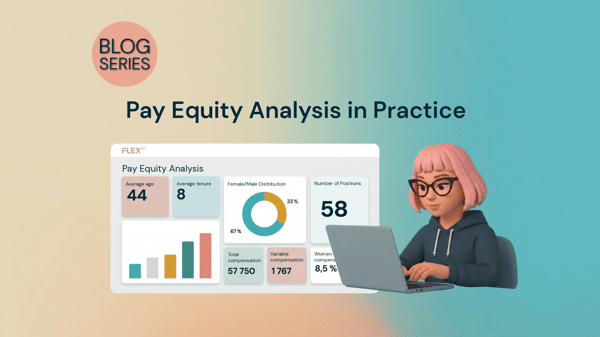
Conducting a pay equity analysis is an effective way to gain a comprehensive understanding of the wage structure in the workplace and ensure that there are no unjustified wage differences based on gender. Many organizations, therefore, choose to complete this process well before the annual salary review. This way, the analysis can provide guidance on the adjustments that are relevant for the upcoming salary review.
Read more: This is how a pay equity analysis works.
2. Get an Overall Picture of Your Employees and Their Performance
How has the employee performed in relation to the goals set up? How have they developed? The salary review is supposed to be based on an overall assessment of the employee's efforts and achievements in the course of the year, and continuous dialogue with your staff provides you with the information you need. Not least, the staff appraisal is an important occasion for such dialogue, so make sure to use of your notes from previous staff appraisals and let them guide you in your assessment.
3. Make Salary Criteria Clear
How familiar are you with the company's salary criteria? And how well do your employees know them? The salary criteria are one of your most important tools in the salary review. They offer concrete guidelines as to what parameters affect the salary and thereby facilitates a consequent assessment and determination of salaries.
In other words, the salary criteria define what achievements, competencies and behaviours of the staff members are important in your organization and should therefore be encouraged. However, to make sure that the salary criteria are effective, they must be communicated to the employees. You also have to make sure that the criteria are interpreted in the same way – perhaps both managers and employees need a review of the concepts and definitions used?
4. Improve Your Salary Discussions
When you are finished preparing the steps in the salary review, it's time for the salary discussion – this is where you communicate and motivate the proposed salary. Are you feeling nervous? You are not alone! However, with thorough preparations a great deal can be done for maximizing the potential of a successful discussion. A few golden rules for the salary discussion:
- Send invitations, including documentation in good time to allow the employees to prepare themselves.
- Give each conversation a decent amount of time – an hour is usually an appropriate length – and make sure you sit in a quiet and secluded place.
- Make sure the employee understands why the salary was set at the current level and what they can do to affect it in the future.
- Be attentive to the employees and allow them to share their thoughts and views. – A template for the wage discussion is recommended to make sure that you don't miss any important details.
Read more: Pay Review Meeting – Checklist for You as a Manager
Bonus Tips: Make Sure to Use a Smart System for the Salary Review
We know, the salary review administration often tends to cause a headache. Without the right tools, you may spend numerous hours collecting data scattered across various systems – or, at worst, on paper sheets. Manual entries and redundant work for managers and HR make the process both dull and bothersome.
Luckily, there are some smart ways to avoid the hassle. When digitalizing your salary review, you can automatize and get rid of unnecessary tasks to save time and enhance the quality of all parts of the process. If you're using the salary review module in Flex HRM – our web-based HRM system, for instance, you will enjoy the following advantages:
- Everything you need for the salary review at one single place – from preparations with the creation of pay pots and the process of determining new salaries carried out by the managers, to the review, approval and finally the wage discussion, implementation and export to your payroll system. Any retroactive pay is also handled in the same smooth workflow.
- Automated checks are used to make sure that you keep within the framework for trade union requirements as well as the company budget – so that you don't have to keep that in mind.
- The graph for gender equality helps in making comparisons between pay levels for men and women and predicting the review's outcome.
- No problems for managers and administrators to work side by side with the salary review. Status bars and intuitive colour graphics help the parties involved to stay updated, from start to finish.
- Convenient digital management of salary discussions. Create templates and let managers and staff members make notes in an easily accessible interface directly in the system. A digital archive allows for smooth access to previous salary discussions.
Sounds good, doesn't it? Our salary review tool is one of several smart features in our HR system Flex HRM Employee and our payroll system Flex HRM Payroll.
Feel free to contact us if you want to know more!